Showing posts with label Reading Notes. Show all posts

Monday, November 28, 2016

Reading Notes A: Russian Fairy Tales

The story of the greedy old reverend and the goatskin is interesting in a mildly disturbing way. He refuses to bury the man's wife without being paid and then when he learns of his great treasure dons a goatskin to sneak in and steal it away from him. The most interesting part is how the skin fuses with him as a punishment though. By ripping off the skin the wife also rips off his real skin.

I think I love the story of the bad wife more than any story i've read so far in this class. It's honestly my favorite. The wife is so contrarian she does everything the opposite of what her husband says even to the point of throwing herself into tartarus. Then she eats all the little demons in there except the one who escapes. That little guy runs quite a racket with the bad wifes husband until he possesses the final woman and he runs off the demon by threatening it with his old wife again. It's really amazing. She was so scary she ate demons and scared them even when she wasn't around. I love russian fairy tales.

The one with the cat is a weird story it all goes very matter of fact but i guess ultimately its about fate and trusting god. the really wasn't any explanation for what happened in the end though i dont know why the eldest brother was a 3 year old.

There's a lot of themes of death and trickery and costumes and fate and being punished or rewarded by god in these stories. All of them kind of go along the same basic lines.

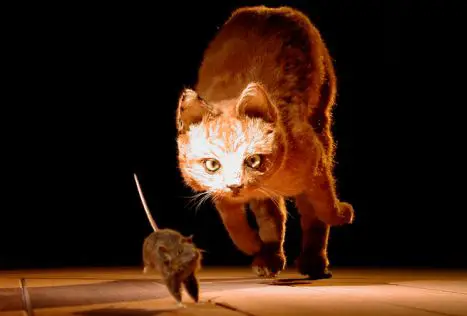
(Cat from the story The Tree Copecks)


Russian Fairy Tales by W. R. S. Ralston (1887)

Wednesday, November 16, 2016

Reading Notes A: Dante's Inferno

I am getting a bit confused by the way things are phrased in this so I'm gonna summarize what seems relevant:

Dante arrives in a horrible forest. He tries to leave towards the light but a lion blocks his path. Turning back around, he meets Virgil who offers to guide him another way through the forest and through hell, after which he will end up passing through heaven with an angelic guide.

The people who are neither evil nor believers are trapped in a sort of limbo. They cannot die but are forgotten and forsaken from the earth and left to be tortured by wasps and worms.

So this is the real limbo. Good Christian people who were never baptized still live in hell. seems pretty harsh. There are people here that are fictional. It's not just a warning for real people then.

I'm a bit confused by the lovers bit. Were they there simply because they fornicated? Or cheated on others? Or are they grouped as lovers but are damned as non-christians? May need to re-read this carefully but i dont get it right now.

Cerberus the guardian eats dirt. River Styx = hatred. people consumed by anger, ripping each other apart, some lie under the water, drowning, sighing

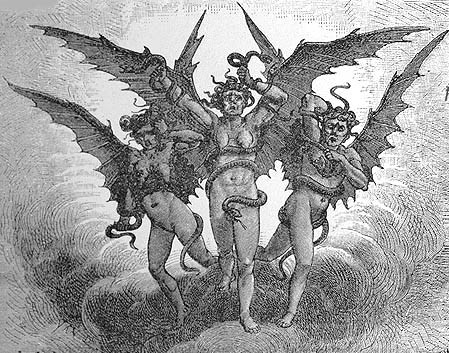
Furies are large, bloody women covered in various kinds of snakes.


Dante's Divine Comedy, translated by Tony Kline (2002)

Friday, November 11, 2016

Extra Reading Notes: King Arthur B

Sir Galahad's tale is one I'd never heard before but it is kind of funny, him running around and fighting with just about anyone. Some of the fights I wasn't even sure why he was doing them other than maybe he just wanted to fight.

There are an awful lot of Christian symbols in the tales of the nights. Being heavy or weighed down by sins is a common theme. All looking for the Grail (Graal).
I was not aware of the idea that a lion was a more natural beast than a serpent. Maybe this has something to do with the snake in the garden of Eden. Also riding a lion is pretty dang cool.

Lancelot is "the best man in the world and the bravest." However he's also very sinful. The concept of sin in this old context is somewhat confusing to me.
There's a lot of voices and hands and visions. It's all meant to be holy but it could be abstracted to something else. Even witchcraft.

There's another sword like excaliber that cannot be drawn from a stone. It's also got blood writing on it though that's a little more menacing.

Only the last story makes any mention of Arthur. Most of these stories are concerned either with sin and fighting or specifically with searching for the Graal.

This has a story of miracle healing by the three knights and the Graal. They get imprisoned for this. Galahaad becomes king. Unexpected.


King Arthur: Tales of the Round Table by Andrew Lang and illustrated by H. J. Ford (1902).

Wednesday, November 9, 2016

Reading Notes: Nursery Rhymes B

there are lots of animal stories with potential to mash together. There's a poor cat who's almost drowned but is saved by a dog. A wedding between a fly and a bee, a flying monster cow???

there's also a recurrent theme of small children doing things together. Jack and jill, the two kids who live in an alley, the man who asked to marry the woman but she wasn't having it. These are all disparate and mildly related but i could splice them together somehow.

Im not sure how two geese could carry the kings daughter over a river but this could be a possible story. it's wild and vague enough i might be able to work with it especially if they perhaps kidnapped her or something.
I might be able to combine it with other bird nursery rhymes but for the most part they are very vague. In this other story a bunch of ducks die from eating polywags. I might include that geese are almost ducks.


The Nursery Rhyme Book edited by Andrew Lang

Tuesday, November 8, 2016

Reading Notes: Nursery Rhymes A

some of these are styled differently from how i remember them. i memorized the whole mother goose book at like age 3 so reading these slightly off rhymes is really weird

the first one that catches my eye is the on old duck hunter who shoots a duck for dinner. the only interesting bit is at the end when he promises his wife he'll go out and shoot a drake. like... a dragon? the duck hunter v the dragon

robbin the bobbin - man who can eat literally anything and anyone and never gets full. either a horror story or a superpower

I might by able to add in the rhyme about the piper's son to the tale of the dragon. if he can make anything dance by playing his pipes that might come in hand to fight a dragon


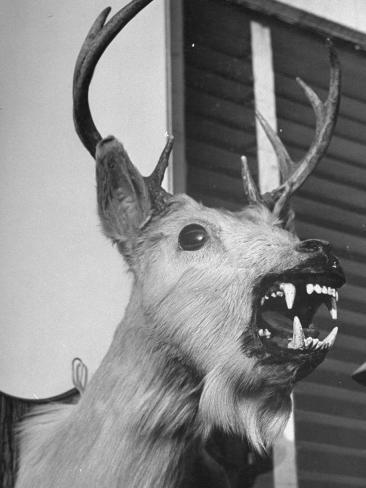
(this probably isn't a hunter but he is fighting a cool dragon)

 The Nursery Rhyme Book edited by Andrew Lang

Wednesday, November 2, 2016

Reading Notes: King Arthur A

I think i might be able to make this one into another comedy. Could be a first person narrative.  Going to be tricky to pull off without making it too kitchy. Also doesn't quite fit with my theme of suburban stories. May rethink this.

Arthur clearly doesn't intend to be king. Kinda occurs  by happenstance for him.
Pulling the sword from the hand in the water is also extremely odd. He's promised some mermaid woman a favor in exchange for this fancy sword the whole deal is shady.
I might also be able to play off merlin getting buried under a rock as a strange coincidental thing especially as he knew it was coming and willingly went to his death. It's all a weird turn of events.
Another odd happening: a guy is killed in his sleep by a mystery dagger while holding a super fancy candlestick.


Tuesday, October 25, 2016

Reading Notes: The Raven Myth A

This myth is long in several parts so it should be the best to get a full story from

First man emerges from a pea pod that raven plants, then raven creates animals like mountain sheep and reindeer for hunting. Lastly he makes a woman for the man who came from the pod. Creation makes raven a very powerful figure but he seems mostly benevolent rather than malicious at least at the moment.
He teaches man to make houses that are strong like beaver's and to use muskrat skin as clothing. He makes bear as a warning not to over-hunt and respect ferocity in nature. He also makes important tools like nets, bows, and arrows from sealskin.

The a-mi-kuk is a really interesting monster and I'm considering abandoning the rest of the myth just to write something about this monster. I love the whole "not being able to escape thing" although I already have something similar with another myth I wrote. I'll ruminate on this.

Now, reindeer kill and eat men for being overpopulated and killing off too many animals. That's kind of weird since reindeer are herbivore but it describes "wolf-like teeth." In order to keep from being eaten, the townspeople set out a bunch of very sour berries. The deer eat them and shake their heads so hard (from the sour?) they loose their sharp teeth. Could capitalize on this in combination with the a-mi-kuk for a monster story.


Myths and Legends of Alaska, edited by Katharine Berry Judson (1911)

Wednesday, October 19, 2016

Reading Notes: California and the Old Southwest

I think the story I like the best at the moment is the fable of the animals. It has some good comedy potential. All the animals have been made and Man is coming in the morning to give them all bows of varying length correlating to their power. Coyote wants the largest bow and stays up all night to be first in line but ends up falling asleep. He then gets the smallest bow and all the animals make fun of him. Man then gives him a consolation prize of 10x as much cunning as he originally had.

It's really simple and short so I'm trying to think of how to spin it. I think I could have kids being given presents by their grandma. One stays up all night to see her in order to get the best gift but she sleeps in. Once she wakes up, her siblings have already claimed their gifts and she gets the one she likes least. Maybe an embroidered pillow or something. As a consolation though, grandma actually teaches her how to embroider, which ends up being a useful skill that none of the others have any patience to learn.


The Fable of Animals, Karuk People's tale. Myths and Legends of California and the Old Southwest by Katharine Berry Judson.

Wednesday, September 28, 2016

Reading Notes: West African Tales B

This story is going to pull together multiple of the west african stories. This will be about a very naive person just trying to get along. There should be three episodes.

Jamal is a bit dumb but well intentioned.  One day all the fruit trees dried up and everyone longs for fruit.  His sister, Tiara, finds an great avacado tree standing by itself which bunches of avacados. She wacks the tree with a big stick several times and avacados fall down. She gathers them and goes home. Jamal tries to do the same but instead of a stick he rams a car into it, knocking the tree down and ruining everything.

Another time, he tells a lizard his best secret. Shortly after he asks the lizard if he has told everyone his own secret and the lizard, as lizards do, bobs it head up and down. He thinks this means the lizard has told and tries to kill the lizard for it but the lizard gets away. He swears revenge on the creature. 

the third story has yet to be worked out. I'll come up with it over the next day.
(Crashed car, source)


West African Folktales by multiple authors

Tuesday, September 27, 2016

Reading Notes: West African Stories A

Although I love these stories I don't find any of them immediately inspiring me for a retelling. The best I have, I think is the pot of wisdom myth. Anansi is offended by men and takes to gathering all knowledge he'd taught back into his pot. He then tries to hide it in a big tree so no one can have it but can't get it up there because his pot is in the way of his climbing. His son then tells him to swing to pot around to his back to climb. He realizes his son still has wisdom he doesn't, smashes the pot, and releases wisdom to the world. It's very short and simple which means I have a lot of room to work with. At the moment I have the idea that someone is collecting something so that no one else can have them. Maybe pokemon cards or the like. When he finds someone else has a very rare object that he covets, he gets angry and scatters all his collectibles away into the sea.

It's a very vague story at the moment. After reading part B, I'll either end up switching to a different story or going ahead and fleshing this one out more.

(image of a pouting child)
West African Folktales by multiple authors

Thursday, September 22, 2016

Reading Notes B: The Tree of Lot

I've decided to scrap the whole of the egyptian myth cause I really wasn't feeling it. I've decided to go with the tree of Lot which I got instant inspiration from.

This starts with Seth planting a tree over Adam's grave. Later, in order to repent for his sins, Lot must water the tree but is constantly spoiled by the devil who keeps drinking his water. Angles water it and later it's cut down to build the cross of christ.

I'm thinking of having this be completely metaphorical. A young woman who lives alone has just lost her first pet, her precious dog, Adam. To commemorate him, she buys an apple sapling and plants it over his grave in her backyard. In the heat of the summer she keeps trying to water it but her hose breaks, she slips and drops her bucket of water and forgets to water it cause she has to shower, and finally the water to her house is cut off during a drought. She's very afraid that the little tree is going to dehydrate in the sun but when she wakes up one morning the rain has generously watered her tree.
Later, she grows older and has to move. While the new patrons are in the house, a great tornado rips to tree nearly out of the ground. They end up having to cut it down but they love the wood so much they use it to build a dog house for their new dog.

Wednesday, September 21, 2016

Reading Notes: Tale of Osiris A&B

I think I'm going to base this one in a typical American suburb. There's going to be a group of kids playing a game. Osiris will be the playground monitor, keeping peace in the kingdom, and Set is a little troublemaker who somehow disables the playground monitor and runs roughshod over the playground with his troublemaker friends. While Osiris is out of commission, Isis, his friend, is desperately trying to get him to the school nurse. Meanwhile, Isis's little brother Horus teams up with his own friends to try to take back the playground from the tyranny of Set. After a set of playground wars, Horus and his friends win and Horus is designated the new playground monitor.

All of this is pretty vague in my head so I'm not 100% committed to it but its a starting point at least. May end up changing either details or the basic premise of the retelling but it'll be something along this vein.

(Kingston Elementary School Park, William J. Kemble) 

Egypt: King of the Dead, Donald Mackenzie 

Wednesday, September 14, 2016

Reading Notes: Tales of a Parrot B

A short bit of notes since i set up most of my story yesterday, sorting through the second half of the stories for one i like.

the third story will be the nobleman who concealed a snake in his sleeve. this story is one of being taken hostage but, in the end, destroying their captor.

most of these stories will be minimally changed besides being shortened considerably. this ends with the woman being killed but that would be a kind of terrible end for the story. i'll just have her be rescued by a search party and the crow can tell them all of the whereabouts of her captor.

(African grey parrot, web source)

 The Tooti Nameh or Tales of a Parrot, by Ziya'al-Din Nakhshabi (1801)

Tuesday, September 13, 2016

Reading Notes: Tales of a Parrot

This starts out as a parrot that can make prophecies. Parrots are an obvious choice for fortune tellers as they are one of the few animals that can mimic human speech. I may change this to a crow since they can also mimic speech and I just really like crows.

If I want to fit in not only the background information but also probably 3 of the stories from this collection I will have to make each section very short. I will need: Introduction -> Story 1 -> Story 2 -> Story 3 -> Conclusion. This will probably take the full 1000 words.

I'm also thinking, rather than an adulterer, this will be a story of a captured young girl, who begs the crow at the window to her room to tell her stories. The crow, being gentle and kind, obliges and tells her stories every night before she sleeps until, in the end, she is rescued.

I'll use the story of the carpenter, goldsmith, taylor, and hermit for one story. The beginning will stay mostly the same but in the end, rather than a tree saving the wooden woman, I think she will simply refuse to be kept prisoner by any of them and will disappear into the night. This should give the imprisoned girl hope for escape.

The Fowler, the Parrot, and her young ones is another tale of imprisonment. These go nicely with my original theme so I will probably use this one unless I find a better one later in the text.

For the third story I will probably look through the second half of the reading tomorrow.

(Manuscript containing Tales of the parrot, 18th century, RCP archives) 


 The Tooti Nameh or Tales of a Parrot, by Ziya'al-Din Nakhshabi (1801)

Tuesday, September 6, 2016

Reading Notes: The Gospel of Mark

I'll be writing on the gospel of mark which is mostly about Jesus's trials and i'm thinking of going an entirely different way with it. I think, perhaps, I want to bring the story into the modern age but with a bit of an irreverent twist. My main idea is to bring Jesus and his apostles entirely out of character and give them the personalities more of skate park bums. Clearly, this is going to end up being a humorous story but I also want to maintain as much of the actual story as I can although I will have to cut a decent bit out to get it under 1000 words.

The Pharisees can be a rival skate gang I think. I'm tempted to go all 90s teen movie on this. The Pharisees are mad that Jesus hangs out with "posers and preps" and tries to teach them how to skateboard. The Pharisees are skateboard purists, only those with the sickest kickflips should be allowed at the skate park but Jesus knows that in order to kickflip you must first learn to ride a board.

When debating with them the proper way to practice Judaism (in the gospel) I may change this to a rap battle? But this may be too hammy. If the story runs too long I may take this out.

The cure for the man with "palsy" who was paralyzed and unable to walk may be a kid whose wheels on his skateboard have broken off. Although everyone at first thinks the board is un-reparable, Jesus is able to reattach the wheels and the kids can skateboard once again.

The apostles squad and their friends have very little money to buy lunch for everyone but Jesus takes their money and is able to buy far more food than anyone expected because, among his many other talents, he is a miracle couponer. He is able to turn their $10.64 into sandwiches and juice boxes for everyone at the skatepark.

I might be able to equate the feat of walking on water to some exceedingly difficult skate trick but I'll actually have to look up what kinds of tricks are particularly difficult and/or dangerous.

Judas dimes Jesus out to the police on faulty vandalism charges and Jesus gets banned from the skatepark and his skateboard confiscated but three days later he returns with his board to throw down a couple more sick tricks before leaving for good.

This should be enough to take up enough room for the story. It might even run long so, if necessary, I can cut a couple of these episodes but I think I included the most popular ones that people remember from the gospel of mark. I also want to make sure that this story is funny but not actually offensive. It's a bit goofy but I want to make sure it's just goofy and doesn't tend into being rude. I will have to watch out for this when writing this project.
(web image, from Photobucket)


Tuesday, August 30, 2016

Reading Notes: The Iliad, B

I wonder just how much I should change this story. It's possible I could base the story around the women with the men fighting consistently in the background, while the women work covertly behind the scenes to manipulate events. That would require an awful lot of rewriting though.

Part B continues with the killing of Patroclus, Achilles' chase and revenge on Hector, and Hector's funeral. Most of this may be irrelevant to the women's story but may be mentioned. All in all, perhaps the women are playing a chess game with the men as pawns. If their magic can influence the minds of men, and if they make pacts with the gods, they could control much of the rise and fall of this story.

The main characters of this would probably be Andromache, Helen, Cryse, and other currently unnamed women who quarrel with each other. Helen would be the most powerful sorceress on the Greek's side, having been kidnapped by Paris, she guides the Greeks to her rescue. Cryse and other women wrong by the Greeks would form the malicious witchcraft of opposition, wanting to punish them for their abuse, while Andromache might be the defensive witch of Troy, and the main reason the city was able to hold for 10 full years of siege before falling. Of course, she couldn't protect Hector, but maybe she had too much confidence in his abilities. Helen would be the most powerful witch involved in the conflict, hence why the Greeks win in the end.

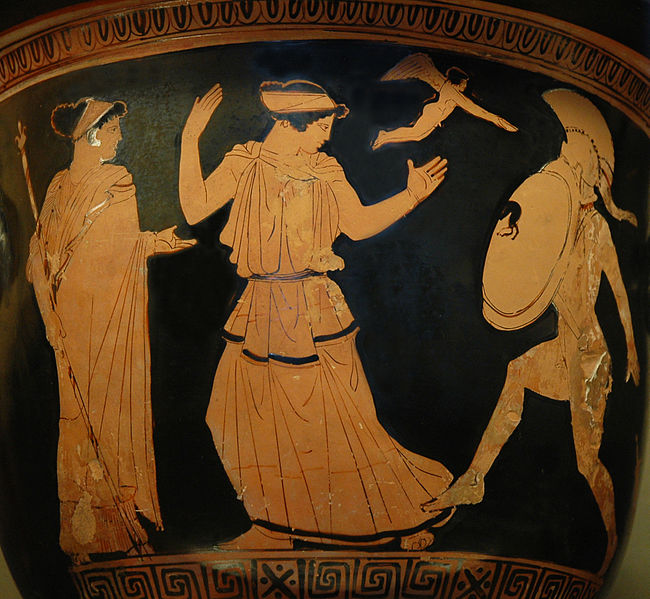
(Image of Helen meeting Menelaus, photographer: Jastrow)

(Story Source: TThe Iliad, retold by Alfred J. Church)

Monday, August 29, 2016

Reading Notes, The Iliad, A

There are two Ajax in this story. I should give them different names.
Agamemnon takes Cryse hostage and plans to carry her back home with him.
I might prefer to have Cryse take more direct action in her rescue. Rather than Apollo punishing the Greeks, I could have Cryse escape and exact revenge on them using witchcraft.
I don't, in fact, like any of the women being treated like playing cards. That was all normal enough in ancient Greece but I may simply cut out the part of Achilles' presumption that he owns the woman he stole. At that, I will have to invent another reason for him to curse Agamemnon and his army.
After losing far too many warriors to Achilles, Hector rallies his troops and fight valiantly against the Greeks, pushing them to desperation.
Agamemnon sends his men to ask Achilles to rejoin the battle armed with promises of riches. Here, leave out the promised slaves. Possibly leave out his daughter's hand in marriage. He refuses.

The source for bitterness could still be witchcraft from the women they wronged on their way to Troy. Have sacked and razed so many cities a multitude of curses could be following the army, turning Agamemnon against Achilles, turning Achilles bitter, and leading to the death of Patroclus.

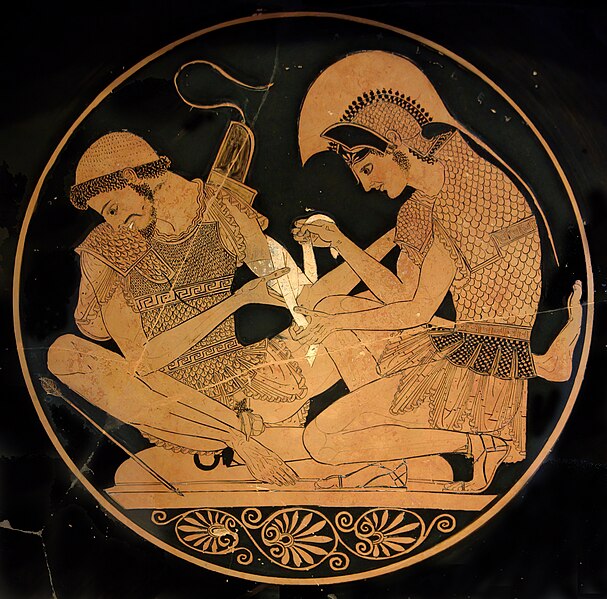
(Image: vase depicting Achilles and Patroclus, picture by Bibi Saint-Pol)
Story Source: The Iliad, retold by Alfred J. Church